
Do they really "represent" us?
In the business world, if a CEO sends someone to a meeting to represent him, he will expect the rep to do exactly as the CEO wishes. In fact the rep will get in trouble if he acts against the wishes of the CEO. I will call this strong representation.
Mixing a rainbow of paints produces an ugly brown
In civic life, we get a single representative for each riding, lets call her Mrs X. She is supposed to represent the entire spectrum of views of the residents in the riding. But at best, she will end up catering to a slice of voters which align with her party.
Even those who voted for Mrs. X may disagree with her strongly on her priorities or her handling of many issues. So she is not accurately representing her electorate.

The form of representation we get in this type of government is very weak indeed. From the perspective of the individual citizen, their elected representative very often does not act as they would like (and there is little we can do about it except vote every so often, which is how we ended up here in the first place). It is truly weak representation.
This may sound so obvious it is not worth discussing. But lets's take a moment to look at this fundamental idea.
Could government be designed so citizens are more accurately represented?
Proportional Representation is one idea, to ensure the mix of elected officials in parliament, ends up closer to the mix of views of the total electorate. That is a step in the right direction, but we could go much further.
There is of course Direct democracy in which the people vote on individual issues, bypassing representation completely. Switzerland does a form of this.
Critics of Direct democracy will say, its better to have well-informed representatives, who have the expertise and time to represent us properly. After all, how can we trust the people to vote wisely on every issue? (Raising the issue, how can we trust the people to wisely choose a representative?)
In reality, its very hard to change the form of government once established. The government itself does not have much incentive to let us restructure it.
But citizens can call their representative! They can write letters! Sign petitions! Organize rallies! This is a free country after all, right? Citizens are free to participate and influence!
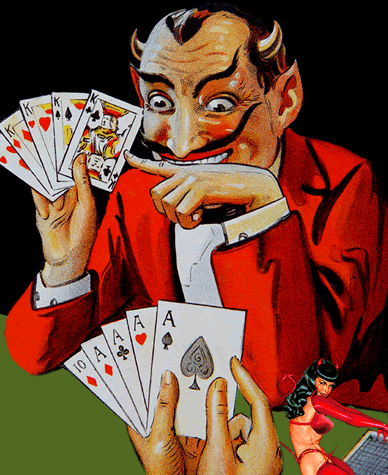
It might look that way. You can play that game. But just like in Vegas, the game is heavily tilted in favour of the house. The burden of citizen activism is very high, by design.
What do we mean by the burden of activism? And what could we do about that? Stay tuned for the next post.

No comments:
Post a Comment